



When I first started building websites, I tuned headlines, inserted keywords, and chased link counts. I believed that search ranking was almost a puzzle to beat. Over time I realised that the real game isn’t about tricks, it’s about being seen as credible, helpful, and consistent. In 2025, when you talk about authority signals in web search, you’re talking about those markers of credibility that search engines use to decide which pages to surface.
What Authority Signals look like today
When you publish a webpage, you don’t just publish text, the page becomes a node in a much larger network of content, users’ expectations, behaviour, and reputation. Authority signals are the evidence points that make a page, an author, or a site stand out as credible in the eyes of a search engine’s system.
In simpler terms: imagine you’re at a conference and you hear someone speak. You’re more likely to trust someone who has a bio, references, past speeches, and endorsements. On the web that translates into author bios, external mentions, clear credentials, and site trust markers.
For example: on one of the websites I help maintain, we added short author bios with links to professional profiles, updated “about” and “contact” pages, and included a simple version of our editorial policy. The result wasn’t overnight traffic surges, but we did observe lower bounce rates and more pages viewed per visit. It wasn’t magical; it was our site simply looking more cohesive and credible.
In 2025, these sorts of signals carry weight:
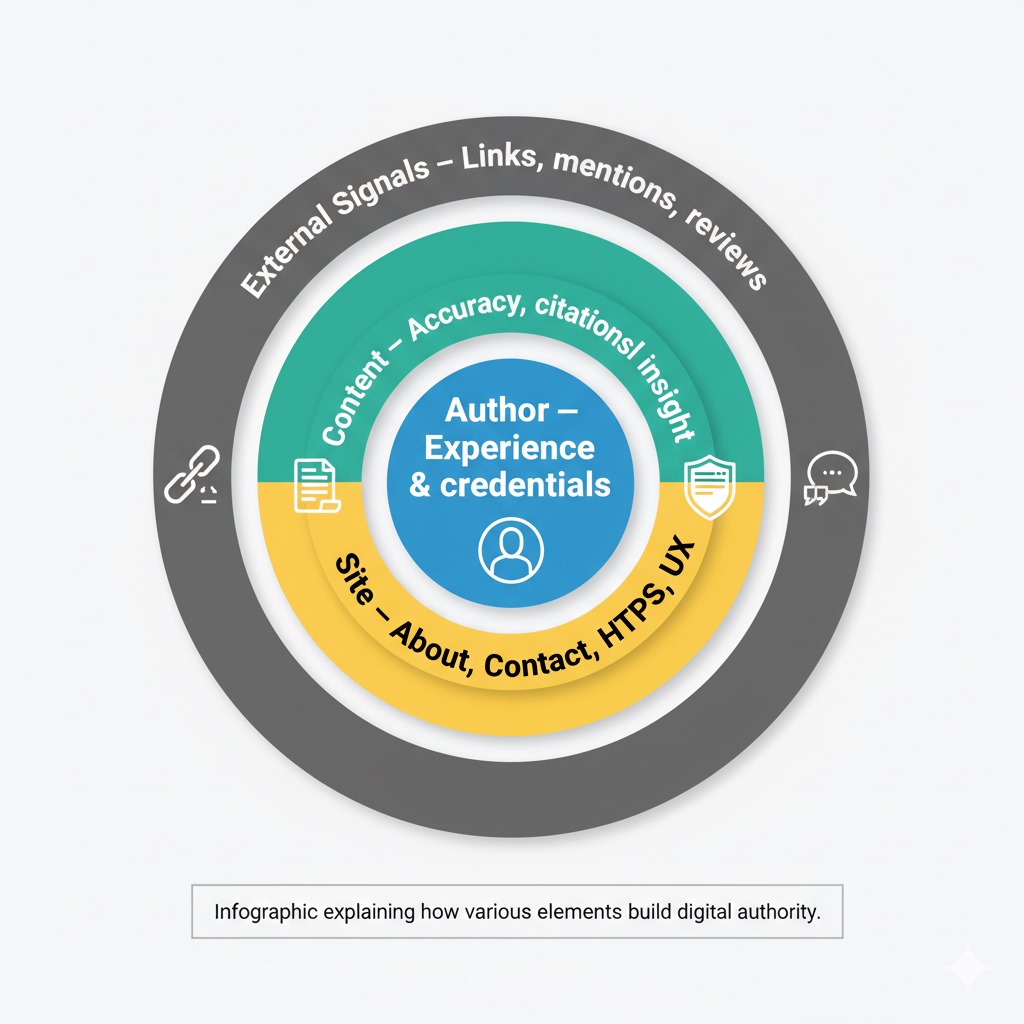
- When other reputable websites link or mention your content, that builds external credibility.
- When your page clearly states who wrote it, their role, and their credentials, that contributes to internal credibility.
- When your site uses secure connections, has clear navigation, and delivers content that people stay to read (rather than bounce immediately), the environment feels more trustworthy.
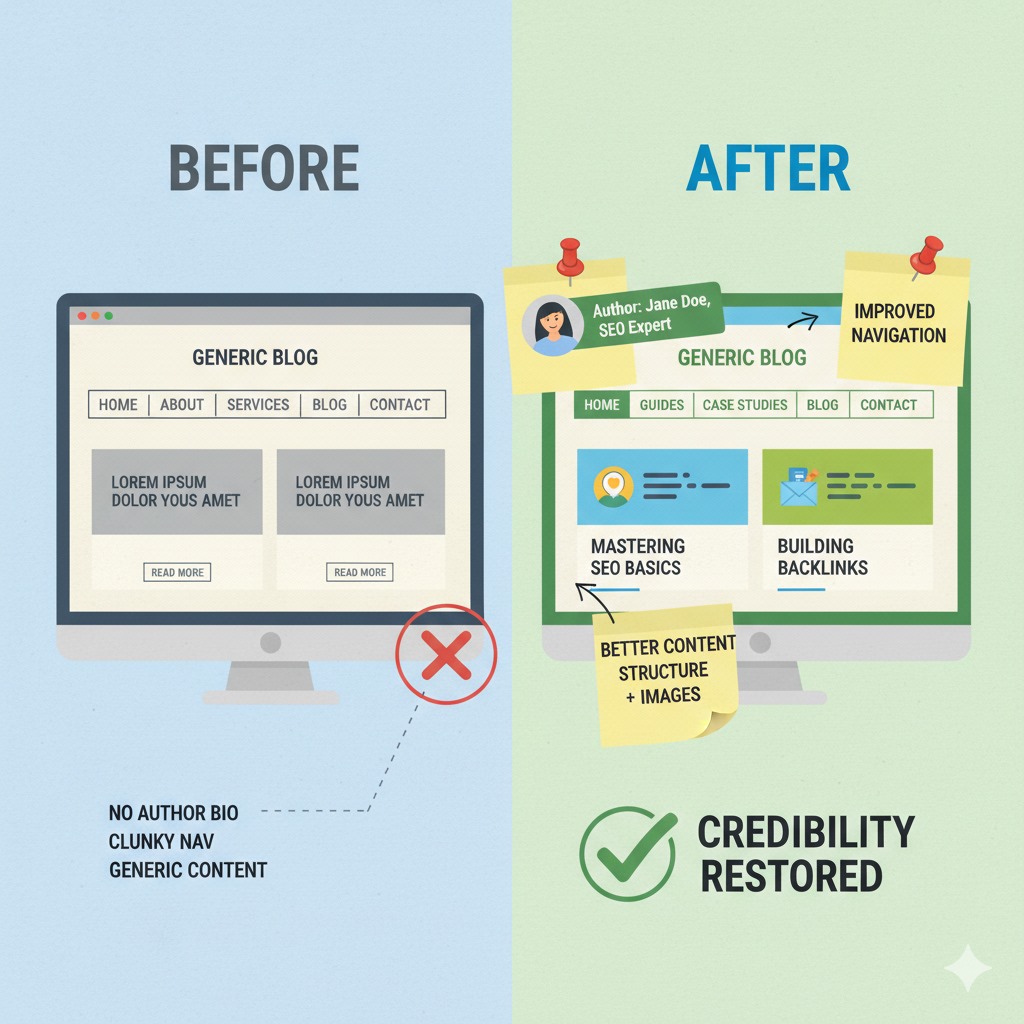
All of this doesn’t guarantee top ranking, but it helps you align with how the systems evaluate content.
Why Search Engines Reward Content Backed by Authority Signals
Search engines exist to serve users: their aim is to deliver pages that meet a user’s question, provide reliable information, and leave the user satisfied.
If a site doesn’t display signs of credibility, the risk is higher that the user will leave quickly, return to search results, and pick something else. Systems learn from these patterns. So when your site exhibits strong authority signals, you reduce the “risk” in the algorithm’s view that your content will disappoint.
To bring it closer: when a health-advice article is written by a recognised expert, cites credible sources, and is hosted on a site with transparent policies, that page is less likely to mislead or fail the user. This results to the algorithm rewarding these signals by giving the content a better chance of ranking.
For example, while auditing content for a cybersecurity client I found pages giving outdated mitigation steps and no author credentials, search engines favor pages that clearly show up-to-date, expert-backed guidance (links to standards, named authors, and evidence of testing). We found that even though the volume of content was high, pages without author credentials or citations performed poorly in search compared to more modest pages that did include those details. So investing in author credibility and site trust turned out to be more valuable than publishing twice the quantity of content.
How You can Build and Signal Credibility
Let’s walk through some key aspects you can address to surface your own authority signals clearly:
Author and Content Credibility
Ensure each major article has a byline with a short author bio. The bio doesn’t have to be monumental, just clear: who the person is, what they do, a link to their profile or past work. In professions like finance, health, legal, this becomes more than optional. It tells the search systems that this isn’t an anonymous piece.
Then, within the content, reference trustworthy sources when applicable. If you’re giving advice, cite the studies or official documents you’ve used. Remember the story above: in that cybersecurity audit, pages with references outperformed those that didn’t. That’s not coincidence.
External Reputation and Links
A few strong pointers here:
- Earn links from sites relevant to your topic and regarded as quality in that niche.
- Encourage mentions of your brand or authors in places beyond your own site such as guest posts, interviews, citations in articles.
- Monitor your backlink profile regularly to avoid spammy or irrelevant links; they create noise around your reputation.
- For local businesses or service-providers, reviews and third-party feedback (Google Business Profile, niche directories) become part of your visible reputation.
Site-Level Trust and User Experience
Don’t assume content alone will carry you. The environment matters. That includes:
- Using HTTPS (secure connection) and avoiding errors like broken links or missing pages.
- Ensuring mobile usability, most users now arrive via mobile, and performance impacts how they engage.
- Structure: clear About, Contact, and Privacy/Terms pages. These may not be glamorous, but they reinforce the “this is a real site” signal.
- Technical performance: pages that load slowly, shift unexpectedly, or block mobile users will lose in the long run.
Original Insight and Depth
One of the most overlooked aspects: you don’t just want to match what others are doing, you want to add something unique. Perhaps you conduct your own data collection, or provide detailed case studies, or share a deep perspective based on your years in your profession.
That extra dimension sets you apart. A blog post that simply re-phrases what’s already out there is one thing; a post that includes your lived experience, your unique take, or even your documented experiments, that one pulls ahead.
Shifts in 2025 that Reshape how Authority Signals Play Out
Since the old days of “build a thousand articles and get a bunch of links,” things are more nuanced now. Here are a few contextual shifts to keep in mind:
- Experience (the “E” in E-E-A-T) has become more visible. Search engines now place more emphasis on creators showing they’ve done the thing they write about (not just studied it). If you write about marketing, sharing real project highlights, lessons learned, tool-choices matters.
- Brand and author identity matter more. Crisp author history, site authority beyond just content, if Google or Bing ‘knows’ you (or your brand) via mentions and context across the web, you get an edge.
- Behavioural signals are increasingly relevant. Engagement metrics, time on the page, return visits, they don’t tell the full story, but they feed systems that refine what shows up for searchers. If your pages consistently leave users dissatisfied (quickly bounce back to results), authority erodes.
- Technical baseline must be strong. Good content can still succeed even if speed is mediocre, but the gap between good content and excellent content widens when your technical and user-experience foundations hold up.
- Niche specificity and trust networks matter. If you’re writing in a specialised field, being connected to trusted hubs in that field (forums, associations, publications) adds rich signal value.
A Realistic Workflow for You
1. Given all this, here’s a gentle workflow, nothing extreme, but effective:
2. Pick your top 5–10 pages (by traffic or business impact).
3. For each page:
- Add or refine the author bio.
- Review the content: does it include real experience or unique insight?
- Check for external, credible links and mentions (both inbound and outbound).
- Review user behavior: use analytics to see bounce rate, time-on-page. If it’s weak, ask: “Does this page genuinely answer a user’s question?”
4. On site level:
- Confirm About/Contact/Policies pages exist and are clear.
- Run a performance audit (mobile, speed, usability). Fix major blockers.
- Monitor your backlink profile and brand mentions (tools like Google Search Console, or niche-specific monitoring).
5. Build from there:
- Once your baseline is better, plan content that uses your unique edge (your professional marketing background). Case studies, tool walkthroughs, lessons learned.
- Seek mentions in reputable venues: professional forums, guest posts, industry newsletters.
- Regularly review metrics: organic traffic, engagement, brand search volume (are people searching your author name or site name?). That’s a subtle but strong reputation indicator.
The Layers Behind Lasting Search Visibility
The path to stronger visibility in search isn’t about one trick or quick fix. It’s layered: you produce content that genuinely helps, you show you have the experience to speak credibly, you build signals externally that others recognise you, and you make sure the site itself behaves like a trusted platform. Over time, those authority signals accumulate and the system rewards that accumulation.